Saturday, November 23, 2013
'Rear Window': superficious suspense
An invalid man with nothing to do for six weeks, except for looking out of his window day in, day out. Occassionaly being visit by his caretaker, a hard-working, sarcastic lady, and his 'to be or not to be' lover, a beautify 'high society' (literally) lady. Sounds like quite a boring setting for a thriller. Yet, when one adds two of the most famous actors of the fifties, James Stewart and Grace Kelly, the film becomes more interesting. A little later, one adds the possibility of 'murder' and the story becomes intriguous. And when we finally mention the name 'Hitchcock', a classic is completed.
'Rear Window' (1954) is a story of a photographer, Jeff, (Stewart) who has broken his leg and who is convicted to six weeks of sitting before his window, doing nothing. However, through his window he has a wide view, and is able to look inside the houses of several of his neighbors. We deal with a typical Greenwich Village apartment block here. Jeff can literally look inside the lives of his neighbors: the pretty dancer 'Miss Torso', the lonely woman 'Miss Lonelyheart', a pianist, a sculptor and, last but not least, Mr. Thorwald, a chubby salesman, and his wife.
One night, Jeff hears a loud 'Don't!' and the breaking of glass. Suddenly the lights in the apartment opposite his house go out and he sees Mr. Thorwald leaving his house in a rush. Immediately intrigued by this weird happening, Jeff pays extra attention to this particular apartment the following days. He discusses his observations with Lisa (Grace Kelly), his girlfriend, and nurse Stella. Lisa is a rich socialite and extremely in love with Jeff. Jeff, on the contrary, is afraid to settle (cliché, cliché) and thinks Lisa is too superficial and too much bound to New York, whereas he travels the world to photograph. Lisa firstly thinks Jeff is exaggerating when he explains his suspicions but soon many strange events follow.
Mr. Thorwald's wife has suddenly disappeared and is never seen again, Mr. Thorwald is seen with strange objects, such as a knife and a heavy suitcase. Whatsmore, a neighbor's dog is found dead and the only one in the apartment block who doesn't come to the window is Mr. Thorwald. Lisa joins Jeff in his obsession and spends many nights at the window as well. The only one who still isn't convinced, is Tom Doyle, a detective and friend of Jeff. Jeff can't keep his mind of Mrs. Thorwald's vanishment and has Lisa sneak into the apartment to settle the matter. Of course, Mr. Thorwald comes home too early and things start to get out of hand really badly.
'Rear Window' is one of Hitchcock's best-rated films, yet I think the story is outrageously shallow. We all know that Jeff will eventually be right about the murder (sorry for the spoiler, but come on, what would have been the use of the film otherwise), we all know that Jeff and Lisa will both survive and yes, we all know Jeff and Lisa will end up together, despite Jeff's difficulties with commiting. Grace Kelly and James Stewart form a magnificent couple together though, typically American, but lovely to look at. Grace Kelly definitely reminded me of our Dutch proud Doutzen Kroes (should be the other way around actually) and she's perfect as the girl-next-door for this film.
Several analyses have been made about the meaning of this film, suggesting it is a reflection of society, of audience and screen and of people's desperate need of looking into the lives of others'. I think the last one is the most logical one, cause I think Hitchcock didn't have a particular deep intention with the film, he probably just wanted a film that sold good and that had some suspense in it. Well, those things definitely worked out well. Though 'Rear Window' is quite predictable, we were definitely on the ball from time to time, especially when someone was approaching Jeff's apartment (who would that be??) and he could impossibly move, because he's wheelchair-bound.
So, final conclusion: 'Rear Window' is not one of Hitchcock's strongest films, due to too much predictability and too little surprise effects. The actors, though being beautiful together, weren't that convincable either but perfect in the way Hitchcock intended them to be: an all-American man as James Steward and an icy blonde as Grace Kelly. Fortunately, 'Rear Window' has some tensious scenes and therefore deserves to be a classic anyway.
'Rear Window' (1954) is a story of a photographer, Jeff, (Stewart) who has broken his leg and who is convicted to six weeks of sitting before his window, doing nothing. However, through his window he has a wide view, and is able to look inside the houses of several of his neighbors. We deal with a typical Greenwich Village apartment block here. Jeff can literally look inside the lives of his neighbors: the pretty dancer 'Miss Torso', the lonely woman 'Miss Lonelyheart', a pianist, a sculptor and, last but not least, Mr. Thorwald, a chubby salesman, and his wife.
One night, Jeff hears a loud 'Don't!' and the breaking of glass. Suddenly the lights in the apartment opposite his house go out and he sees Mr. Thorwald leaving his house in a rush. Immediately intrigued by this weird happening, Jeff pays extra attention to this particular apartment the following days. He discusses his observations with Lisa (Grace Kelly), his girlfriend, and nurse Stella. Lisa is a rich socialite and extremely in love with Jeff. Jeff, on the contrary, is afraid to settle (cliché, cliché) and thinks Lisa is too superficial and too much bound to New York, whereas he travels the world to photograph. Lisa firstly thinks Jeff is exaggerating when he explains his suspicions but soon many strange events follow.
Mr. Thorwald's wife has suddenly disappeared and is never seen again, Mr. Thorwald is seen with strange objects, such as a knife and a heavy suitcase. Whatsmore, a neighbor's dog is found dead and the only one in the apartment block who doesn't come to the window is Mr. Thorwald. Lisa joins Jeff in his obsession and spends many nights at the window as well. The only one who still isn't convinced, is Tom Doyle, a detective and friend of Jeff. Jeff can't keep his mind of Mrs. Thorwald's vanishment and has Lisa sneak into the apartment to settle the matter. Of course, Mr. Thorwald comes home too early and things start to get out of hand really badly.
'Rear Window' is one of Hitchcock's best-rated films, yet I think the story is outrageously shallow. We all know that Jeff will eventually be right about the murder (sorry for the spoiler, but come on, what would have been the use of the film otherwise), we all know that Jeff and Lisa will both survive and yes, we all know Jeff and Lisa will end up together, despite Jeff's difficulties with commiting. Grace Kelly and James Stewart form a magnificent couple together though, typically American, but lovely to look at. Grace Kelly definitely reminded me of our Dutch proud Doutzen Kroes (should be the other way around actually) and she's perfect as the girl-next-door for this film.
Several analyses have been made about the meaning of this film, suggesting it is a reflection of society, of audience and screen and of people's desperate need of looking into the lives of others'. I think the last one is the most logical one, cause I think Hitchcock didn't have a particular deep intention with the film, he probably just wanted a film that sold good and that had some suspense in it. Well, those things definitely worked out well. Though 'Rear Window' is quite predictable, we were definitely on the ball from time to time, especially when someone was approaching Jeff's apartment (who would that be??) and he could impossibly move, because he's wheelchair-bound.
So, final conclusion: 'Rear Window' is not one of Hitchcock's strongest films, due to too much predictability and too little surprise effects. The actors, though being beautiful together, weren't that convincable either but perfect in the way Hitchcock intended them to be: an all-American man as James Steward and an icy blonde as Grace Kelly. Fortunately, 'Rear Window' has some tensious scenes and therefore deserves to be a classic anyway.
Monday, November 11, 2013
Sunday, November 10, 2013
Latest repertoire is perfect for Dylans raspy voice
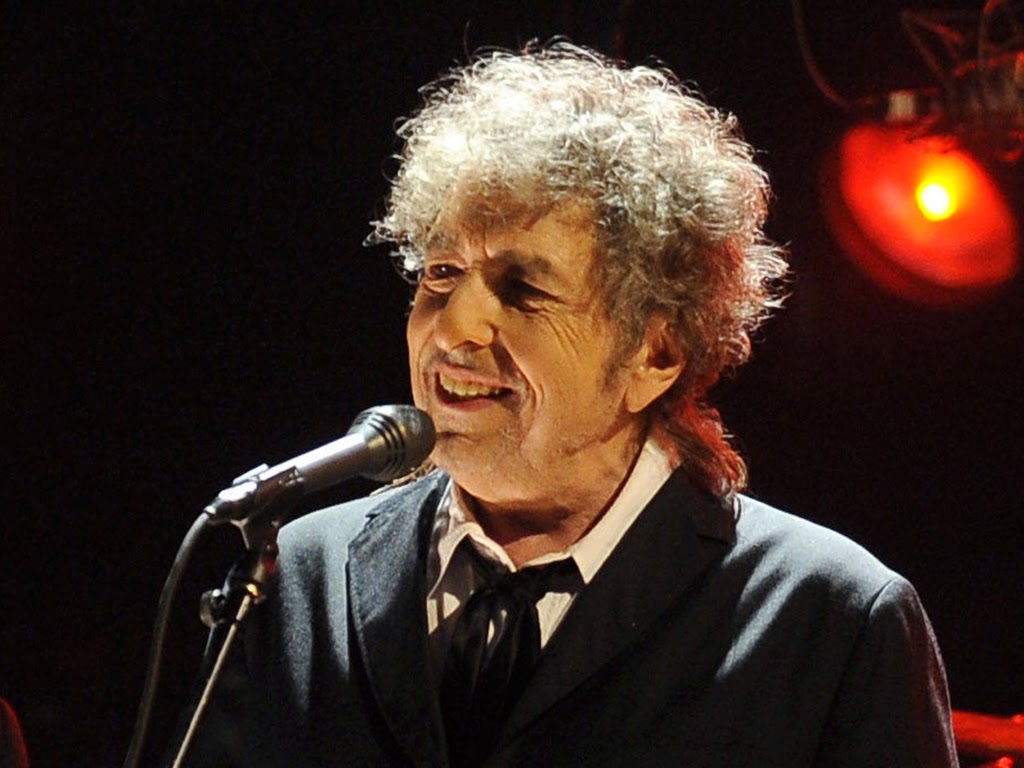
Is a 72-year old guy still capable of giving a convincing performance for an audience of old critical fans? That was the question that arose when I heard the announcement that folk- and rock legend Bob Dylan would give two concerts in the Heineken Music Hall in Amsterdam. His age was clearly visible: wild curly and grey hair, a stiff stance and a marked face. The Dylan of the sixties is vaguely recognisable, but the most important question is to what extent that accounts for his brilliant musicality.

Along with the first notes that are striken, it becomes clear that his voice has adopted a great dose of rawness over the years. Dylans voice is hoarse, gruff and so grumbling that it makes Tom Waits sound sweet. This voice matches the songs of his latest record 'Tempest' perfectly, on which blues and folk have a leading role. The grumbling gives force to the heavy blues, which is played in a convincing manner by the band.
The performance of classic hits as 'She Belongs to Me' and 'Tangled up in Blue' is more like a quest for recognition. The known repertoire might be given a new dimension by the unrecognisable performance of the songs, but it is very clear that this dimension isn't a positive one. Because of the fact that the lines are hard to recognize, it's impossible to sing along and so the audience stands straight and static, such a shame. Also, the grumpy grumbling doesn't show a lot emotion. Dylan seems to want to get rid of the songs and he shows this quite obviously.
After a break of half an hour - after all, Dylan is an oldie - there's more speed in the show. The energy is back and we see this in songs as 'Early Roman Kings' and 'Duquesne Whistle'. Dylans strong voice sounds convincing and it underlines the darkness of a song as 'Pay in Blood'.
The recent song 'Forgetful Heart' tops things off. A beautiful ballad which, this time comprehensible, brings up emotions both in the audience and for his Bobness. The quite reserved audience gives a tremendous applause in the middle of the song. Dylan shows his sensitive side when pronouncing the words 'All night I lay awake and listen to the sound of pain'. His voice is strong and accurate, which feels quite penetrating, but in a good way.
The band adapts itself formidable to Dylans tone of voice and gives a bit more swing in the show. Dylan shows various musical sides as well. When he's playing the tambourine, the old Bob returns for a bit. He does this quite pure. Dylan plays the piano and guitar as well and proves to be quite musical after all this time.
Unfortunately, the dynamics on stage, stays on stage. Dylan is known for his boring concerts, due to a limited interaction with the audience. And indeed, the nights isn't filled with talks and thanks. Even worse: Dylan doesn't show any affection at all. This may seem indifferent, but it adds to his image. His crusty and moody and rebellious image, which gives him an air of mystery. And nothing's wrong with that, if you ask me.
Despite this, Dylan isn't too faint and returns - after having left the stage - back to delight the audience with two classics. When hearing the beginning tunes of 'All Along the Watchtower' a loud cheering fills the hall. 'Blowin in the Wind' is received enthusiastically as well. As much as the performance went up after the break, as much as it went down again now. It becomes clear at once that Dylan is best to limit himself to his new songs. The classics sound cliché, too easily gotten rid of and brought with less emotions than the new ones. The themes that Dylan brings forward with these two songs, are hard to translate to 2013. Racial segregation is no longer an issue and Dylan feels this as well.
To be honest, all classics Dylan performs in the two hours are hard to transfer to his current voice. That voice is raw, that voice is raspy and this makes this voice right for the heavy blues of 'Tempest'. That's why Dylan should listen to his own voice - as he has done all his life - and focus on his latest repertoire. The latest repertoire that was brought to us tonight in a convincing manner, sensible and with a strong teamwork. Hat off for the new Dylan.
Tuesday, October 29, 2013
The illusion of perfection when no one is proud
I never saw myself burning in the flames of the fire
Neither did I imagine climbing a hill having no hope
I never saw myself pushing and squeezing and forcing
For something already broken before even created
For something that needed damage in order to be fixed
The battle that’s in front of us needs to be fought
In order to make a journey we must have a suitcase
To be filled with desire, with memories, with taste
Of an unforgettable incomparable and irreversible time
When mornings were bloomy and nights were bright
But light needs darkness and pleasure needs sorrow
So thunder filled the air and all that’s left was
tomorrow
Tomorrow, when the task asks for a beginning to be
made
In order to obtain respect and pride we all need to
work
Ideas must fill the air, the illusion of originality
exists
What is the function of perfection when no one is
proud
For creation is cumulative and completion cannot be
found
This world is filled with insecurities that need to be
smashed
That need to be cursed and damaged like the flesh of a
deer
Since no hero ever gave up and so must society as we
know it
I have always done what was expected for the ultimate
goal
What a delusion when goals are meant to be shifted
away
I have always performed for myself in order to win
respect
Only for me since the people are placed in a position
of power
But what’s the use of winning when the competition is you
I have often wondered what it was that I had to do
Burning and running and falling and rising back up in
the air
To once be a tower standing solid between the comfort
of clouds
Or wondering wise why we do what we do and what’s to
be found
And standing with my tiny feet between all the others
on the ground
Take a walk on the wild side of heaven, Lou.
To be honest, I hadn't heard anything anymore from the legendary Lou Reed in the last five years. I had no idea how old he was, if he was still active in music and how his health was. Maybe that was why his death came as such a shock for me. Lou Reed, the singer of one of my favourite songs 'Take a walk on the wild side' (I recall having posted a video of that song on my blog a couple of years ago, because the lyrics appealed so much to me), Lou Reed, who once wrote the startling lyrics of 'Heroin' (When the heroin is in my blood/and that blood is in my head/then thank God that I'm as good as dead/then thank God that I'm not aware/And thank God that I just don't care) and Lou Reed, the leadsinger of the Velvet Underground, the student of Andy Warhol and the lover of Nico.
Yes, this was Lou Reed and Lou Reed is now dead. He died of liver disease, tragically as this may be, it is the death of a rockstar, who shot his soul to the sky by drinking litres and litres of liquor. Half a year before he underwent a liver transplant, which made him feel 'stronger and bigger than ever' (for a 71 year-old, that's quite an accomplishment). But last Sunday his body was broken, his body finally gave up and Lou Reed died in his home in New York. Anything but a perfect day.
Lou Reed was born in Brooklyn as Lewis Allan Reed. Though he was Jewish, he claimed his religion to be rock 'n roll. Following this religion, he learned to play the guitar and joined several bands in his youth. Being a bisexual in the times before the openminded sixties, he received electroconsulvive therapy as a teenager, which was said to heal his bisexuality. Ridiculous of course, and quite traumatic.
He studied journalism, creative writing and film directing at university, after which he hosted a late-night radio program which played mostly rhythym and blues and free jazz. This was a huge inspiration source for him, many of his guitar-techniques were inspired by jazz saxophonists (God, what a masterous genre, jazz!) A couple of years later, Lou began working as an in-house songwriter for Pickwick Records. his is where he met John Cale, with whom he later formed 'The Velvet Underground' (Maureen Tucker and Sterling Morrison joined as well). The Velvet Underground had little commercial success but would later turn out to be a huge cult-hit, also thanks to the famous banana cover by Andy Warhol and the collaboration with Nico.
In 1970, Lou left The Velvet Underground and began a solo career. In my opinion, his best songs include the ones from 'Transformer' and 'Rock 'n Roll Animal' (with the Bowie-style cover, Lou wearing heavy make-up and looking quite freaky). The 'Rolling Stone Magazine' critic Stephen Holden said the following about Reed's voice on 'Transformer': ''Reed's voice hasn't changed much since the early days. Outrageously unmusical, it combines the sass of Jagger and the mockery of early Dylan, but is lower-pitched than either'. What a compliment...
'I love you' and 'Heroin' show the softer side of Lou Reed, which I definitely prefer. 'Take a walk on the wild side' is still my absolute number one. The lyrics of this song are build up so perfectly fine. The funny thing is that each of the song's verses describe a tragic fixture of The Factory: Candy Darling, Holly Woodlawn, ''Little Joe'' Dallesandro, ''Sugar Plum Fairy'' Joe Campbell and Jackie Curtis. Lou didn't stop working until 2010, mostly doing covers but also recording new material.
His personal life was pretty interesting too (all his relationship with musicians, women, men, all of that) but I'm not going to turn this post in a history of Lou. His music is definitely worth listening to and if you're not in the position to listen to his fabulous records, just look him up on YouTube. The world has lost another legend (I think I'm going to use this as standard line with my posts now, happening way too often) but at least, he's reborn a bit through his music. At least, in my bedroom. Thanks, Lou.
Yes, this was Lou Reed and Lou Reed is now dead. He died of liver disease, tragically as this may be, it is the death of a rockstar, who shot his soul to the sky by drinking litres and litres of liquor. Half a year before he underwent a liver transplant, which made him feel 'stronger and bigger than ever' (for a 71 year-old, that's quite an accomplishment). But last Sunday his body was broken, his body finally gave up and Lou Reed died in his home in New York. Anything but a perfect day.
Lou Reed was born in Brooklyn as Lewis Allan Reed. Though he was Jewish, he claimed his religion to be rock 'n roll. Following this religion, he learned to play the guitar and joined several bands in his youth. Being a bisexual in the times before the openminded sixties, he received electroconsulvive therapy as a teenager, which was said to heal his bisexuality. Ridiculous of course, and quite traumatic.
He studied journalism, creative writing and film directing at university, after which he hosted a late-night radio program which played mostly rhythym and blues and free jazz. This was a huge inspiration source for him, many of his guitar-techniques were inspired by jazz saxophonists (God, what a masterous genre, jazz!) A couple of years later, Lou began working as an in-house songwriter for Pickwick Records. his is where he met John Cale, with whom he later formed 'The Velvet Underground' (Maureen Tucker and Sterling Morrison joined as well). The Velvet Underground had little commercial success but would later turn out to be a huge cult-hit, also thanks to the famous banana cover by Andy Warhol and the collaboration with Nico.
In 1970, Lou left The Velvet Underground and began a solo career. In my opinion, his best songs include the ones from 'Transformer' and 'Rock 'n Roll Animal' (with the Bowie-style cover, Lou wearing heavy make-up and looking quite freaky). The 'Rolling Stone Magazine' critic Stephen Holden said the following about Reed's voice on 'Transformer': ''Reed's voice hasn't changed much since the early days. Outrageously unmusical, it combines the sass of Jagger and the mockery of early Dylan, but is lower-pitched than either'. What a compliment...
'I love you' and 'Heroin' show the softer side of Lou Reed, which I definitely prefer. 'Take a walk on the wild side' is still my absolute number one. The lyrics of this song are build up so perfectly fine. The funny thing is that each of the song's verses describe a tragic fixture of The Factory: Candy Darling, Holly Woodlawn, ''Little Joe'' Dallesandro, ''Sugar Plum Fairy'' Joe Campbell and Jackie Curtis. Lou didn't stop working until 2010, mostly doing covers but also recording new material.
His personal life was pretty interesting too (all his relationship with musicians, women, men, all of that) but I'm not going to turn this post in a history of Lou. His music is definitely worth listening to and if you're not in the position to listen to his fabulous records, just look him up on YouTube. The world has lost another legend (I think I'm going to use this as standard line with my posts now, happening way too often) but at least, he's reborn a bit through his music. At least, in my bedroom. Thanks, Lou.
Friday, October 18, 2013
Ballad of Bob
Seeing my biggest hero in two weeks! I know, I know, everyone keeps saying that his concerts are pretty lousy, but I don't care. I'm not going to be able to spend my life knowing I had the chance to see him when he's dead. Cause let's stay realistic, he's not going to live forever. His body though, his music will of course ;) Bob Dylan is known to be not that nice a guy, especially to all of his lovers he was quite horrible. That is, a great lover and poet in the beginning and easily dropping them for someone new (how easily Sara replaced Joan Baez). Anyways, he does know how to sing about the ladies.
''You've been with the professors
And they've all liked your looks
With great lawyers you have
Discussed lepers and crooks
You've been through all of
F. Scott Fitzgerald's books
You're very well read
It's well known.''
Outstanding guy, Bob.
''You've been with the professors
And they've all liked your looks
With great lawyers you have
Discussed lepers and crooks
You've been through all of
F. Scott Fitzgerald's books
You're very well read
It's well known.''
Outstanding guy, Bob.
Saturday, October 12, 2013
Suffer is an artist's seed
My bag was filled with no expectations
Not in order to diminish the illusions in my head
For I only felt fear of empty relations
I never thought I’d feel comfortable in your bed
Established thoughts released from a spinning mind
We talked about art, about literature, about life
Your wise words and my curiosity perfectly combined
Through us the legends of the past could easily
survive
Minor magic moments arose from the waves of the sea
If this was happiness, I would know where to look
I would know how my body could finally be free
And how Kerouac put that thought into his famous book
Mystery appeared when you showed me your inner soul
It was not that I felt a distance, it was rather close
indeed
But it was the lightness in me that you secretly stole
Sadness is the base of beauty and suffer is an artist’s
seed
Instinctively I knew that I had never been one to
belong
My mind had always been lost and my feelings quite
intense
Still had it been you that made the confusion so
strong
Do I feel heavier or lighter after this short yet pure
romance?
The connection is damaged and everything is dust
Yet the relief is tremendous since it was not only
lust
It was an easy route
to a troubled life, the life of the dazzling damned
Subscribe to:
Posts (Atom)